


pengenalan
Understanding the relationship between genes and their functions is crucial for genetic counselors in today’s complex healthcare environment. As advancements in functional genomic analysis continue to emerge, these professionals have the opportunity to enhance patient care through tailored risk evaluations and effective communication strategies. However, the rapid evolution of technology, coupled with ethical considerations, raises an important question: how can genetic counselors ensure they are prepared to meet the challenges of this dynamic landscape?
Understand the Principles of Functional Genomic Analysis
Understanding the relationship between genes and their functions, particularly how genetic variations influence phenotypes and disease susceptibility, is essential through functional genomic analysis. Genetic advisers must grasp key concepts such as:
- Gene expression
- Regulatory elements
- The significant role of epigenetics
This foundational knowledge is crucial for accurately interpreting genetic test results and effectively communicating their implications to patients.
For example, comprehending how specific mutations impact inherited conditions enables advisors to provide tailored risk evaluations and management strategies. Additionally, staying updated on advancements in functional genomic analysis, including CRISPR technology and gene therapy, equips professionals to navigate emerging treatment options.
Recent studies indicate that approximately 11 percent of hereditary variants display different behaviors when interacting with nearby variants, highlighting the complexity of gene interactions. By integrating this knowledge into practice, hereditary advisors can enhance patient care and foster informed discussions about the evolving landscape of research and its implications for health.
Leverage Digital Tools for Enhanced Data Management
Digital tools, such as TrakGene’s smart pedigree chart maker and online family history questionnaires, play a crucial role in modern genetic counseling. These platforms empower counselors to create detailed family histories and integrate genomic health records seamlessly. This integration ensures access to accurate and comprehensive data, which is vital for effective risk assessment and communication with individuals.
For instance, the use of integrated Human Phenotype Ontology (HPO) terms enhances the categorization and sharing of phenotypic information. This improvement facilitates clearer conversations with individuals, fostering better understanding and engagement.
Moreover, implementing secure data management practices is essential. Adhering to standards such as HIPAA and GDPR, along with the ISO27001 Information Security Management System, is critical for protecting confidentiality and maintaining trust in the counseling process.
As the field evolves, the importance of these digital tools continues to grow, significantly enhancing the efficiency and effectiveness of biological services. Ethical considerations, particularly the necessity for informed consent and respect for individual autonomy, are paramount in preserving trust as digital tools become more integrated into practice.
Lastly, sharing narratives or brief examples of successful applications of TrakGene’s tools in clinical settings can provide valuable insights for advisors. This approach also addresses potential challenges, such as the importance of maintaining personal connections with individuals to support emotional well-being and informed decision-making.
Implement Effective Communication Strategies with Patients
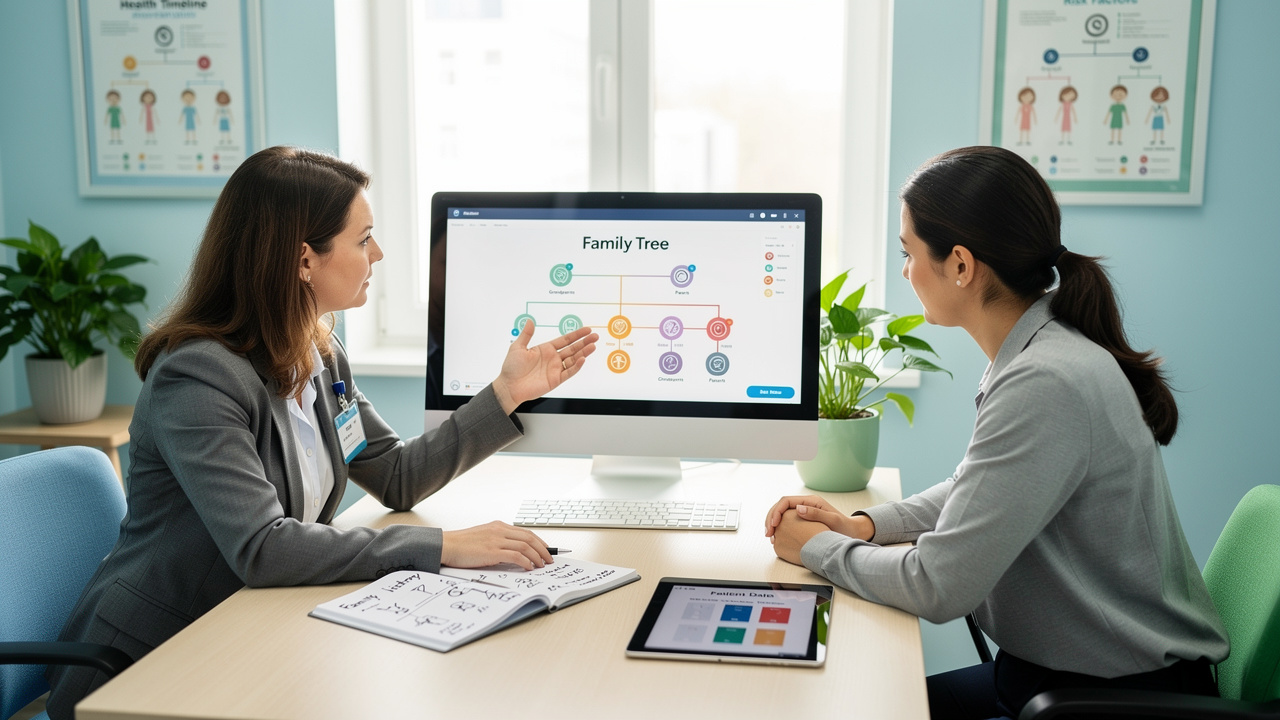
To effectively convey genomic information, counselors must adopt strategies that enhance understanding and promote client involvement. This involves using clear, non-technical language when discussing test outcomes and actively listening to individuals’ concerns. Visual aids, such as TrakGene’s automated pedigree chart creator, are essential for helping individuals visualize their sejarah keluarga and comprehend hereditary risks.
Recent updates to TrakGene’s Portal Penglibatan Pesakit have significantly expanded its functionalities, providing advisors with improved tools for user interaction and data management. Additionally, employing motivational interviewing techniques fosters open dialogue, allowing individuals to express their emotions and choices regarding testing and management options. By asking open-ended questions, advisors can encourage individuals to articulate their thoughts, leading to a more personalized and impactful support experience.
Moreover, insights from initiatives like The 100,000 Genomes Project can inform advisors about advancements in digital pedigrees and precision medicine, thereby enhancing their ability to assist patients in understanding their hereditary information.
Commit to Ongoing Education and Professional Development
Genetic advisors must prioritize ongoing education to remain informed about advancements in genomics and guidance methodologies. This includes participating in workshops, webinars, and conferences that focus on the latest research and technologies in genetic counseling. For example, the National Society of Genetic Counselors (NSGC) offers a comprehensive 2026 Webinar Series, featuring 24 webinars that provide 1 Category 1 Contact Hour each, available until the end of 2027. These sessions cover relevant topics such as genome sequencing as a primary prenatal diagnostic test and standardized genetic testing guidelines for ataxias, which are essential for enhancing diagnostic accuracy and care quality.
Pursuing certifications and continuing education units (CEUs) not only bolsters a professional’s credentials but also deepens their expertise. Engaging with professional organizations like the NSGC provides valuable networking opportunities and access to resources that support professional growth. Participation in case discussions and peer evaluations fosters collaborative learning, allowing practitioners to integrate client and caregiver narratives into their practice, thereby improving communication and support. This commitment to professional development ultimately leads to better outcomes in genetic counseling, equipping counselors to navigate the complexities of genetic disorders and serve their patients more effectively.
Kesimpulan
In conclusion, understanding functional genomic analysis is essential for genetic counselors, as it equips them with the necessary knowledge to interpret genetic variations and their implications for patients. By mastering the principles of gene expression, regulatory elements, and epigenetics, counselors can deliver tailored risk assessments and management strategies that significantly enhance patient care. Furthermore, staying informed about technological advancements, such as CRISPR and gene therapy, empowers professionals to adeptly navigate the evolving landscape of genetic counseling.
The integration of digital tools, including smart pedigree charts and online family history questionnaires, greatly enhances data management and communication. These tools streamline the risk assessment process and facilitate clearer conversations with patients, fostering engagement and understanding. Ethical considerations, such as informed consent and data protection, remain paramount as technology becomes increasingly integrated into practice. Additionally, ongoing education and professional development are crucial for counselors to remain current with advancements in genomics and to improve their expertise.
Ultimately, embracing best practices in functional genomic analysis, leveraging digital tools, and committing to continuous learning are vital for genetic counselors. By doing so, they can provide exceptional care, support informed decision-making, and effectively navigate the complexities of genetic disorders. As the field continues to evolve, a dedication to improving communication and patient engagement will not only enhance the quality of care but also empower individuals to take charge of their genetic health.
Soalan Lazim
What is functional genomic analysis?
Functional genomic analysis involves understanding the relationship between genes and their functions, particularly how genetic variations influence phenotypes and disease susceptibility.
Why is it important for genetic advisers to understand functional genomic analysis?
It is crucial for genetic advisers to grasp key concepts such as gene expression, regulatory elements, and the role of epigenetics to accurately interpret genetic test results and communicate their implications to patients.
How do specific mutations impact inherited conditions?
Understanding specific mutations allows advisers to provide tailored risk evaluations and management strategies for inherited conditions.
What advancements in functional genomic analysis should genetic advisers be aware of?
Genetic advisers should stay updated on advancements such as CRISPR technology and gene therapy, which equip them to navigate emerging treatment options.
What do recent studies indicate about hereditary variants?
Recent studies indicate that approximately 11 percent of hereditary variants display different behaviors when interacting with nearby variants, highlighting the complexity of gene interactions.
How can integrating knowledge of functional genomic analysis improve patient care?
By integrating this knowledge into practice, hereditary advisors can enhance patient care and foster informed discussions about the evolving landscape of research and its implications for health.
List of Sources
- Understand the Principles of Functional Genomic Analysis
- News: CMN Weekly (20 March 2026) – Your Weekly CRISPR Medicine News – CRISPR Medicine (https://crisprmedicinenews.com/news/cmn-weekly-20-march-2026-your-weekly-crispr-medicine-news)
- This CRISPR breakthrough turns genes on without cutting DNA (https://sciencedaily.com/releases/2026/01/260104202813.htm)
- CRISPR Clinical Trials: A 2026 Update (https://innovativegenomics.org/news/crispr-clinical-trials-2026)
- Scientists sharpen genetic maps to help pinpoint DNA changes that influence human health traits and disease risk (https://jax.org/news-and-insights/2026/february/scientists-sharpen-genetic-maps-to-help-pinpoint-dna-changes-that-influence-human-health-traits-and-disease-risk)
- Gene Editing Breakthrough Offers New Hope for Head and Neck Cancer Patients – ChristianaCare News (https://news.christianacare.org/2026/01/gene-editing-breakthrough-offers-new-hope-for-head-and-neck-cancer-patients)
- Leverage Digital Tools for Enhanced Data Management
- Impact of Digital Tools on Knowledge, Genetic Counseling, and Testing Uptake: A Systematic Review and Meta-analysis – PubMed (https://pubmed.ncbi.nlm.nih.gov/41688281)
- Online Tool Enables Communication of Genetic Testing Results With Family Members – Drugs.com MedNews (https://drugs.com/news/online-tool-enables-communication-genetic-testing-results-family-members-129425.html)
- The Future of Genetic Counseling: Integrating Technology and Personalized Care (https://raveco.com/blog/the-future-of-genetic-counseling-integrating-technology-and-personalized-care)
- Impact of a digital platform on genetic counselling encounters in the screening context – European Journal of Human Genetics (https://nature.com/articles/s41431-026-02029-6)
- Utilization of health information technology among cancer genetic counselors – PMC (https://pmc.ncbi.nlm.nih.gov/articles/PMC7434745)
- Implement Effective Communication Strategies with Patients
- Picture this: Evaluating the efficacy of genetic counseling visual aids – PubMed (https://pubmed.ncbi.nlm.nih.gov/38251422)
- SCU’s Dr. James Whedon receives NBCE Research Award (https://scuhs.edu/mshgg-article/effective-patient-advocacy-strategies-in-genetic-counseling-and-genomics)
- Visual communication aids now live on GeNotes – Genomics Education Programme (https://genomicseducation.hee.nhs.uk/news/visual-communication-aids-now-live-on-genotes)
- Picture this: Evaluating the efficacy of genetic counseling visual aids – PMC (https://pmc.ncbi.nlm.nih.gov/articles/PMC11632560)
- Redefining “Effective Communication:” Supporting Patients With Hearing and Vision Loss in Genetic Counseling (https://perspectives.nsgc.org/Article/redefining-effective-communication-supporting-patients-with-hearing-and-vision-loss-in-genetic-counseling)
- Commit to Ongoing Education and Professional Development
- Florida Association of Genetic Counselors – 2026 Annual Education Conference (https://floridagenetics.org/event-6506605)
- 2026 Webinar Series Purchase Options (https://nsgc.org/Education-and-Events/Online-Education-Center/Product-Details/2026-webinar-series-purchase-options)
- 2026 Hereditary Cancer Genetics: Incorporation into Clinical Care – Memorial Sloan Kettering Continuing Medical Education – Continuing Education (CE) – 2026 Hereditary Cancer Genetics: Incorporation into Clinical Care (https://mskcc.cloud-cme.com/course/courseoverview?P=5&EID=58981)
- Webinar Series (https://nsgc.org/webinars)




 Bahasa Melayu
  English (UK)
  Suomi
Suomi  Français
  Deutsch
  हिन्दी
  Italiano
  Español
  සිංහල
සිංහල  Cymraeg
  English
  English (Canada)
  English (Australia)