

Bonjour depuis le soleil de Glasgow, en Écosse ! Je m'appelle Matt et je suis conseiller en génétique chez TrakGene. Chaque mois, j'espère écrire un article sur une personne célèbre et inclure une copie de son arbre généalogique ou de son pedigree. Aujourd'hui est le dernier jour de la conférence éducative de la Société européenne de génétique humaine et j'ai passé un très bon moment. Avec plus de 2 000 délégués, c'était formidable de retrouver des collègues du monde entier. Chaque fois que je voyage, j'emporte mon sac TrakGene. Mon doodle Banjo sait que chaque fois que ce sac sort, son papa s'en va. Maintenant, je pourrais parler de Banjo pendant des heures et j'ai peut-être montré une ou deux (ou plusieurs) jolies photos de mon précieux chiot aux participants à la conférence ESHG. Mais ce que tout le monde ne sait pas, c'est que notre banjo porte en fait le nom d'un célèbre Australien ; Andrew Barton « Banjo » Paterson.
Banjo Paterson was born on February 17, 1864, in New South Wales, Australia. His upbringing on his family’s rural property exposed him to the vast landscapes that would later become the backdrop of his famous poems. Paterson’s early experiences in the Australian bush likely nurtured his deep connection to the land and the people who inhabited it. Banjo Paterson’s poetry often revolved around the natural world, painting vivid pictures of the Australian landscape. Paterson’s ability to evoke the essence of the outback suggests a deep connection and appreciation for the natural world.
Call me a proud Aussie, but Banjo Paterson’s ability to capture the essence of Australia’s outback and its people through his poetry will forever remain a testament to the power of artistic expression and the indomitable spirit of a nation.
Most Aussies know of Banjo Paterson. He is a celebrated poet and is featured on our $10 note. Even people not from Australia may be familiar with his poems Waltzing Matilda or The Man from Snowy River. “The Man from Snowy River” and “Waltzing Matilda” are two iconic works by Banjo Paterson that have become integral parts of Australian folklore and cultural identity. “The Man from Snowy River” is a stirring narrative poem that tells the story of a young mountain horseman’s daring ride to rescue valuable horses from the treacherous slopes of the Snowy Mountains. Paterson’s vivid descriptions and skillful storytelling transport readers to the rugged Australian bush, capturing the spirit of adventure, determination, and the strong bond between man and horse.
“Waltzing Matilda,” on the other hand, is perhaps Australia’s most famous folk song, with lyrics penned by Paterson. This ballad follows the tale of a swagman, a wandering worker carrying his belongings in a “Matilda” (a swag or bedroll), who meets a tragic fate at a remote waterhole. The song resonates with the Australian spirit of independence, resilience, and the plight of the working class. It has come to symbolize the struggles and triumphs of ordinary Australians, evoking a sense of national pride and nostalgia for the country’s pioneering history.
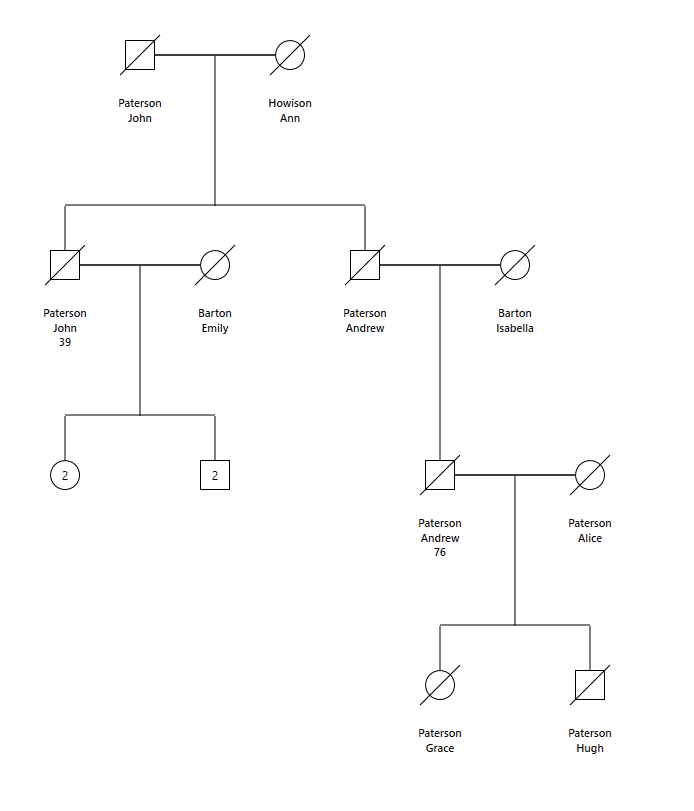
But I must admit I did not know much about him or his family. His father was from Lanarkshire, which is not too far from where I am now in Scotland. His mother is thought to be related to Australia’s first Prime Minister Edmund Barton. He came from a family with Scottish and Irish heritage, both regions known for their strong literary traditions. The Scottish connection likely contributed to his appreciation for storytelling and the power of words, while the Irish influence might have influenced his love for music and rhythm. Paterson’s family history also reflected the pioneering spirit of Australia, as his ancestors were early settlers in the New South Wales region. This deep connection to the land and its people, passed down through generations, likely played a significant role in his ability to capture the essence of the Australian outback and its inhabitants in his poetry. I have drawn his family tree. Check it out!
 Français
  English (UK)
  Suomi
Suomi  Deutsch
  हिन्दी
  Italiano
  Bahasa Melayu
  Español
  සිංහල
සිංහල  Cymraeg
  English
  English (Canada)
  English (Australia)